In late October 2026, Binance disclosed a major security incident involving billions of dollars in digital assets. The exchange’s updates described unauthorised withdrawals and an investigation into compromised infrastructure.
The incident raises questions that extend beyond cryptocurrency: how should businesses protect employee devices, limit privileged access, and supervise automated systems?
There is an important distinction between explaining the published findings and claiming to know the complete cause. The full attack sequence was still under investigation in the official updates reviewed for this article.
What Happened at Binance?
In its October 30 update, Binance said its hot wallets were compromised at approximately 20:05 UTC on October 29, with about $6.3 billion in token assets stolen.
A hot wallet is connected to online infrastructure so it can support transactions. That makes the security of the surrounding services and authorisation process especially important.
The FBI’s October 31 advisory attributed the theft of more than $6 billion to North Korea, identifying the activity as TraderTraitor.
These reports concern Binance in October 2026. They are separate from the Bybit theft in February 2025 and the BNB Chain bridge exploit in 2022.
What Do We Know About the Breach?
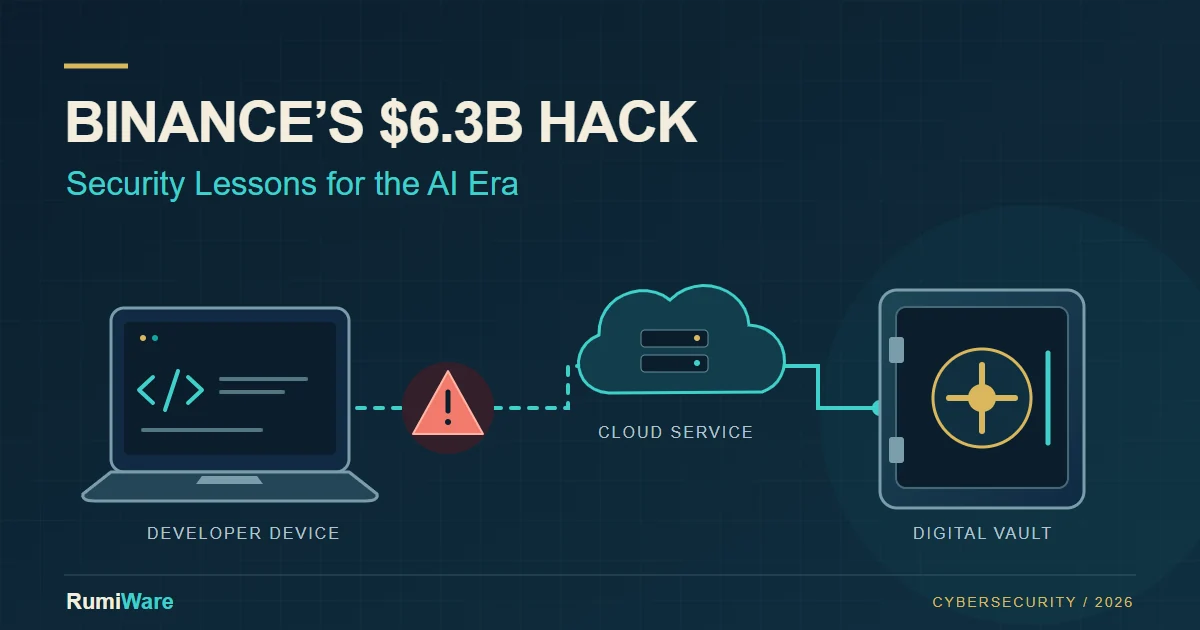
Binance’s initial announcement suggested that a compromised DevOps engineer’s laptop allowed access to a service container and the submission of unauthorised withdrawal transactions.
DevOps involves the systems and processes used to build, deploy, and operate software. Accounts and devices used for this work can have access to sensitive infrastructure.
However, Binance’s subsequent update said investigators had identified additional breach points. It also said no evidence of wallet private-key leakage had been found at that stage.
The complete root cause should therefore not be reduced to one employee’s laptop. The initial device compromise is a preliminary finding within a wider investigation.
Why Private-Key Protection Alone Is Not Enough
A system can face serious risks even when investigators have not identified a leaked wallet key.
Financial operations also depend on accounts, permissions, services, approval rules, and transaction policies. Protecting secrets is essential, but organisations must also control what an authenticated service is allowed to do.
For example, a service may legitimately request transactions but still need limits on destinations, transaction values, frequency, or approval requirements.
This is a general security principle, not a confirmed reconstruction of every step in the Binance attack.
The important question is broader than “Are our keys protected?” It is also: “What could someone do if one trusted account, device, or service were compromised?”
Frozen, Recovered, and Replenished Funds Are Different
Financial updates after a theft can be confusing.
- Frozen assets are restricted from moving; they are not necessarily returned to the victim.
- Recovered assets have been regained through a recovery process.
- Replenished assets are replacement funds supplied or purchased to cover a shortfall.
In its November 1 recovery update, Binance said it had covered approximately 95% of the impacted amount and had scheduled the first phase of withdrawal restoration for November 1, between 06:00 and 09:00 UTC. That schedule does not confirm that every asset or network is available; users should check Binance’s official withdrawal status for their selected asset and network.
The company stated that it would absorb the financial impact rather than pass it to users. These are Binance’s statements about its response, not an independent guarantee of platform safety.
Covering a loss using company resources is not the same as recovering that percentage of stolen assets from the attackers.
Was Artificial Intelligence Used in the Attack?
The sources reviewed for this article do not establish that AI was used to carry out this Binance theft.
Nevertheless, the incident provides a useful starting point for discussing security as businesses adopt AI tools.
The FBI has separately warned that criminals can use generative AI to produce convincing fraudulent messages, impersonation materials, and cloned voices.
For a business, this means a polished message or familiar-sounding caller is not enough to authenticate a sensitive request.
AI can also introduce risk when assistants are given broad access to files, cloud systems, or operational tools. Those permissions need the same care as permissions granted to people and applications.
Seven Security Improvements for Businesses
The following recommendations are general defensive lessons. They are not claims that Binance lacked every control mentioned, or that any single measure would have prevented the incident.
1. Protect Administrative Accounts and Devices
Use separate administrator accounts and keep developer devices updated. Avoid using privileged accounts for ordinary browsing or opening unexpected attachments.
Enable phishing-resistant authentication, such as supported passkeys or security keys, for email, source-code hosting, cloud services, and domain administration.
Protect recovery methods as carefully as normal login credentials.
2. Reduce the Reach of a Compromised Account
Give people and services only the access required for their current tasks.
Separate development and production environments. Use limited-duration credentials where practical, and remove unused access.
Ask a concrete question during reviews: if this account is stolen today, which systems could the attacker reach?
3. Control Important Actions Beyond Login
Successful authentication should not automatically authorise every operation.
Use appropriate approval requirements, transaction limits, destination controls, or additional verification for consequential changes.
For payment-detail changes, contact the person through an established channel. Do not rely on a phone number supplied inside the request itself.
4. Secure Builds and Deployments
Protect deployment credentials and review changes to CI/CD workflows—the automated processes that test and release software.
Require meaningful review for sensitive changes, restrict who can deploy, and record what was released.
A passing test suite is useful evidence, but it does not establish that every permission, dependency, or business rule is secure.
5. Keep Secrets and Customer Data Out of Unapproved AI Tools
Do not paste production passwords, private keys, recovery phrases, or confidential customer information into general-purpose prompts.
Use suitable secret storage and narrowly scoped access. If a credential is exposed, revoke or rotate it; deleting the visible text does not invalidate copies already made.
Review the permissions of coding assistants and integrations before connecting them to production systems.
6. Supervise AI Actions and External Content
An AI assistant reading an email, webpage, or document can encounter instructions planted by an attacker.
Treat that material as information to assess, not authority to reveal secrets, approve payments, or change account permissions.
Start with read-only access where possible. Require explicit approval for consequential operations, and log tool actions so they can be reviewed.
7. Monitor, Contain, and Practise Recovery
Monitor unusual logins, new privileged accounts, unexpected deployments, and abnormal transaction activity.
Define who can revoke sessions, pause an affected integration, and investigate alerts.
Keep protected backups of important data and configuration, and test restoration. Backups can support system recovery, but they do not reverse an unauthorised blockchain transfer.
What Individual Users Should Do
During a major exchange incident, fake support messages and recovery offers can add to the damage.
Use official applications and bookmarked support channels. Never disclose a seed phrase, password, or one-time login code to someone offering assistance.
Review account sessions and API access, and remove integrations you no longer use. Where available, enable strong authentication and withdrawal-address protections.
If an account appears compromised, use the provider’s official support process from a trusted device. Avoid installing remote-access software at the request of an unsolicited caller.
Frequently Asked Questions
Was this actually Binance rather than Bybit?
Yes. This article concerns the October 29, 2026 Binance incident. The February 2025 Bybit theft was a separate event.
Is the complete cause known?
Not from the official updates reviewed here. Binance initially described a possible compromised laptop and later reported additional breach points.
Does “95% covered” mean 95% of stolen funds were recovered?
No. Coverage can include replacement assets purchased with company resources. Frozen, recovered, and replenished funds describe different things.
Does two-factor authentication prevent every attack?
No. Strong authentication is valuable, but organisations must also protect active sessions, devices, permissions, services, and approval workflows.
Should businesses stop using AI?
AI use should be matched with suitable controls. Limit permissions, protect sensitive information, review generated work, and require human approval for consequential actions.
The Lesson: Protect the Entire Workflow
The Binance incident shows why security discussions must extend beyond passwords and private keys.
Businesses need to consider the complete path from an employee device to a production service and, ultimately, to an action affecting money or customer information.
For organisations adopting AI, the same principle applies: useful automation needs clear permissions, independent checks, and a tested recovery process.
If you are planning a website or business application, contact RumiWare to discuss requirements, access responsibilities, and maintenance from the beginning.
Sources and Further Reading
- Binance: Initial Security Incident Update, October 30, 2026
- Binance: Security Incident Update #2, October 30, 2026
- FBI: North Korea Responsible for $6 Billion+ Binance Attack, October 31, 2026
- Binance: Recovery Update #4, November 1, 2026
- FBI: Criminals Use Generative Artificial Intelligence to Facilitate Financial Fraud